

September
Welcome to my offering for September

The first of September saw the beginning autumn – at least meteorologically speaking. Astronomically, it starts on 22nd September at the time of the autumn equinox.
Either way it’s a turning point in the year. The days are getting shorter and the temperature is dropping, both of which affect wildlife in the garden: this season’s queen bumblebees start to hunker down in a cosy spot to emerge next spring to start a new colony; most butterflies and moths enter a dormant phase as an egg, larva, pupa or adult insect, depending on the species, and some migrate to warmer climes; swallows, house martins and swifts head off to sunnier spots for the winter.
The beginning of autumn sees the garden entering a new phase too. Most people think of spring as the start of the gardening year, but in autumn I like to think about what new things to do in the garden, rather than leaving them until spring. For example, if you want to create a new veg patch, now is the time to do it before the winter sets in; also, you can move plants so that they can establish before next spring; and spring-flowering bulbs need to be planted in the autumn – the subject of an article this month.
So without more ado, what else is coming up this month?
Well, we have:
· my Pollinator Plant of the Month
· we’re taking a look at Michaelmas
· a quiz
My Pollinator Plant of the Month for September is neither a single plant, nor do the ones I’ve chosen flower in September. So what’s going on? Well now is a good time to plant spring flowering bulbs. (I’m also including corms under the umbrella term of bulbs, although strictly speaking they are different.)
So rather than wait until spring and point out all the lovely flowers that you could have planted, I thought I would suggest a few bulbs that you can plant now, many of which are ideal food sources for bees and other pollinators at a time when there is often little else to sustain them.
Before we look at the individual bulbs, let’s spend a few moments going through the planting procedure. Generally speaking, all bulbs should be planted three times their own depth so if you have a 5cm bulb then it should be covered with 10cm of soil. But – there’s always a ‘but’ - always be guided by the planting instructions that you get when you buy your bulbs: the grower or supplier has years of experience, so take notice of what they say.
So let’s have a look now at some pollinator-friendly bulbs which, simply for convenience, I’ve listed in alphabetical order. Incidentally, all of them can also be planted in pots or containers.


First up is Camassia. There are several species of Camassia, all of which are good for pollinators: it’s the nectar they go for. Depending on the species, the spikes of blue or white flowers will reach a height of between 60cm and 90cm, so they’re not exactly retiring in their demeanour. In fact, they look stunning when planted in a meadow-type situation. They’ll grow in sun or part shade, although like any other plant that is attractive to pollinators, they (the pollinators) will head for the ones in sun first. Give them moist but not waterlogged soil – err on the side of free-draining soil if in doubt – and they will flower from April to June, again depending on the species. Camassia are both hardy and perennial, so once planted they will produce flowers year-on-year.
Second is Crocus. If I could plant only one spring-flowering bulb, crocus would be it. I knew for a while that it was good for pollinators, and particularly bees, and this was overwhelmingly confirmed when I visited a park (see picture) near where we used to live one spring morning. It was a carpet of crocus which had naturalised, and it was simply thrumming with bees of all sorts. I’m yet to discover if one species of Crocus is any better for pollinators than another, but it does appear to be the purple-flowered ones which are most popular. Don’t be surprised if you find a queen bumblebee tucked up in one of the flowers having a snooze – the flowers close overnight and make a snuggly bed for a tired bee.
Eranthis hyemalis, or winter aconite comes next. These are some of the earliest flowering bulbs whose blossoming more-or-less coincides with the emergence of the first bumblebees from their winter sojourn, providing them with an essential source of nectar and pollen. Eranthis aren’t statuesque, growing only to about 10cm but what they lack is stature they make up for in their dazzling, sunshine colour. They favour part-shade and do particularly well under trees and shrubs where they will gradually spread if they are not disturbed. If you do want to move them to a different location, this is best done ‘in the green’, before the leaves die back.


Next is Galanthus, snowdrops. I for one take the name snowdrop for granted but it struck me as I was writing this that it really is one of those words which describes the object exactly – the little flower does indeed look like a drop of snow. But I digress. Galanthus is one of the earliest flowering of all bulbs showing itself from January onwards in an average year. This may be way too early for a number of pollinators, but some will be out and about during late winter if the weather is clement looking for food. If the Galanthus like where they have been planted, they will form vast natural drifts over the years – a beautiful sight which some garden owners share when they open their gardens to the public. Like Eranthis, Galanthus are best planted or transplanted ‘in the green’.
There are a number of Muscari species, but it is the traditional Muscari armeniacum which seem to attract most pollinators, especially bees. Otherwise known and grape hyacinth, these little clusters of bells grow to about 20cm in height and can cope with just about any soil type, in sun or part shade. A word of warning, however – they do naturalise very easily, so if you don’t have much room, plant them in pots.
My next two bulbs that should be planted in the autumn, but which aren’t spring-flowering (they bloom a fraction later in the year) are two that I wouldn’t be without in a pollinator-friendly garden. The first is Allium. I could write a whole post about Allium but suffice it to say that if you’re serious about attracting bees to your garden, you need Allium!
I have to admit to being a bit confused over the name of my next bulb. I have always known it as Nectaroscordum siculum subsp. bulgaricum, but on the RHS website it’s Allium siculum subsp. dioscoridis. The Kew database has both listed as synonyms. Ho hum. Anyway, whatever you know it as, it’s common name of ‘honey garlic’ sums up its attributes a treat – it does indeed smell of garlic, but at the same time it’s a magnet for bees, and honeybees in particular. It’s statuesque, with its stems topped by floppy bells growing up to 1.2m. It will grow in sun or part shade in just about all kinds of soil as long as they aren’t waterlogged. And if you see the flowers standing erect rather than drooping, you know they have been pollinated.
You may be wondering why I haven’t included Narcissus or Tulipa in my list. It’s true that some - especially the simple species of each - are good for pollinating insects, many of the hundreds, if not thousands, of named varieties have been developed with a view to looking good to us humans, rather than being of benefit to pollinators. That’s not to say we shouldn’t grow them – they just won’t attract our buzzy friends as much as we would wish.
Michaelmas
The end of the month, the 29th September in fact, sees the feast of Saint Michael the Archangel. Now he is a pretty powerful entity: he is the patron saint of the sea and all maritime matters including ships and sailors, and of horses and horsemen. But his coup d'etat is throwing the devil out of Heaven because of his treachery – so Saint Michael also became the guardian against evil and darkness.


Which brings me nicely to blackberries (Rubus fruticosus). Why blackberries? What have they got to do with Michaelmas, I hear you say. Well, apparently, when Saint Michael hurled the devil from Heaven, he (the devil) landed on a blackberry bush. Now, as we know, blackberry bushes are covered in nasty thorns so you imagine the response from the devil when he landed in one. He cursed the fruit, spat on them, charred them with his fire-hot breath and made them totally unfit for human consumption. Therefore, so the saying goes, you shouldn’t pick blackberries after Michaelmas Day. There is a slight problem with the timing, however, since the current calendar (the Gregorian calendar) was introduced in 1582 - before then the Julian calendar was used which places Saint Michael’s Day on 10th October. The question is, are you willing to risk picking blackberries up to 10th October? I’ll leave it with you.
While you’re deciding, let’s have a look at the blackberry itself. I have to say I have spent many an afternoon picking blackberries from the hedgerows. These are the ones that grow wild, and as the devil found out, have a very good defence mechanism – nasty, vicious thorns. They certainly don’t give up their harvest without a fight. If you would like to grow some in your garden, I would steer clear of the wild form. There are many cultivated varieties to choose from, including thornless ones such as ‘Loch Tay’, ‘Loch Ness’, or ‘Oregon Thornless’, which makes life so much easier when it comes to tending them and picking the fruit. Cultivated varieties also produce bigger fruits and higher yields than the native blackberry – between 4.5kg and a whopping 12kg per plant, depending on the variety.
Blackberries are vigorous plants so you should take this into account when deciding how many plants to grow – check on the label, which should give information about spacing and so on. The majority of plants seem to be available pot-grown, which is handy because you can plant them at any time of year, as long as the ground is not too wet or frozen. They can cope with part-shade but will be much happier in a sunny spot with moisture-retentive but free-draining soil. Give them a dose of general-purpose fertiliser (about 100g per square metre) sprinkled on the surface of the soil in mid-spring, and an annual mulch of home-made compost or similar. You will also need to supply the canes with a sturdy support system, either by means of wires secured to a wall or stout fence, or stretched between two vertical posts.
The fruit is borne on year-old canes, so once a cane has produced berries it should be untied from its support and cut down to ground level. New canes which grow from the base can then be tied in to the wires to replace the old ones.
By the by, we say blackberry but apparently, it’s not a berry at all but what is known as an aggregate fruit consisting of little ‘drupelets’. I think I’ll stick to blackberry – it sounds so much better than blackdrupelets.
Another horticultural subject associated with Michaelmas is, of course, the Daisy.
Now to most people Michaelmas Daisy = Aster. But back in 2015 some members of the Aster genus suddenly found themselves reclassified as Symphyotrichum. Why the change? Suffice it to say that originally a plant was included in a particular group because of its visible characteristics. With advances in genetic technology, however, it has now been discovered that many plants aren’t what they seem. It appears that some aren’t as closely related to others as was first thought, and vice versa. Which is what has happened to a number of plants formerly known as Aster.
That’s why some of our old friends the Michaelmas Daisy – which used to be called Aster novi-belgii or Aster novae-angliae – now find themselves with the monikers Symphyotrichum novi-belgii and Symphyotrichum novae-angliae. Incidentally, S. novae-angliae, the New England aster and S. novi-belgii, the New York aster, were introduced to Britain in the 17th Century from America (New England, as it was then) by John Tradescant the Younger, part of the intrepid father-and-son plant-hunter duo.


Whatever their name they are some of the best autumn-flowering perennials, although a few gardeners avoid them because of their susceptibility to mildew. It is true that some older varieties, particularly the S. novi-belgii cultivars, suffer from this affliction, but newer ones appear to be less vulnerable.
Taller varieties of Symphyotrichum will benefit from the Chelsea Chop (see below *). Some can reach quite a height – in fact I have in the back of my mind a poem which visualises Michaelmas Daisies growing so tall, that they peek over the garden wall – but I can’t for the life of me remember when or where I read it. I’m including that little nugget here just to illustrate how tall some can grow.
One Aster that remains Aster, however, is Aster x frikartii. To my mind one of the best varieties is ‘Mönch’. It has masses of lavender-blue flowers with orange centres held above dark green leaves, and it is pretty well trouble-free. It looks good with just about anything you plant alongside it, too.
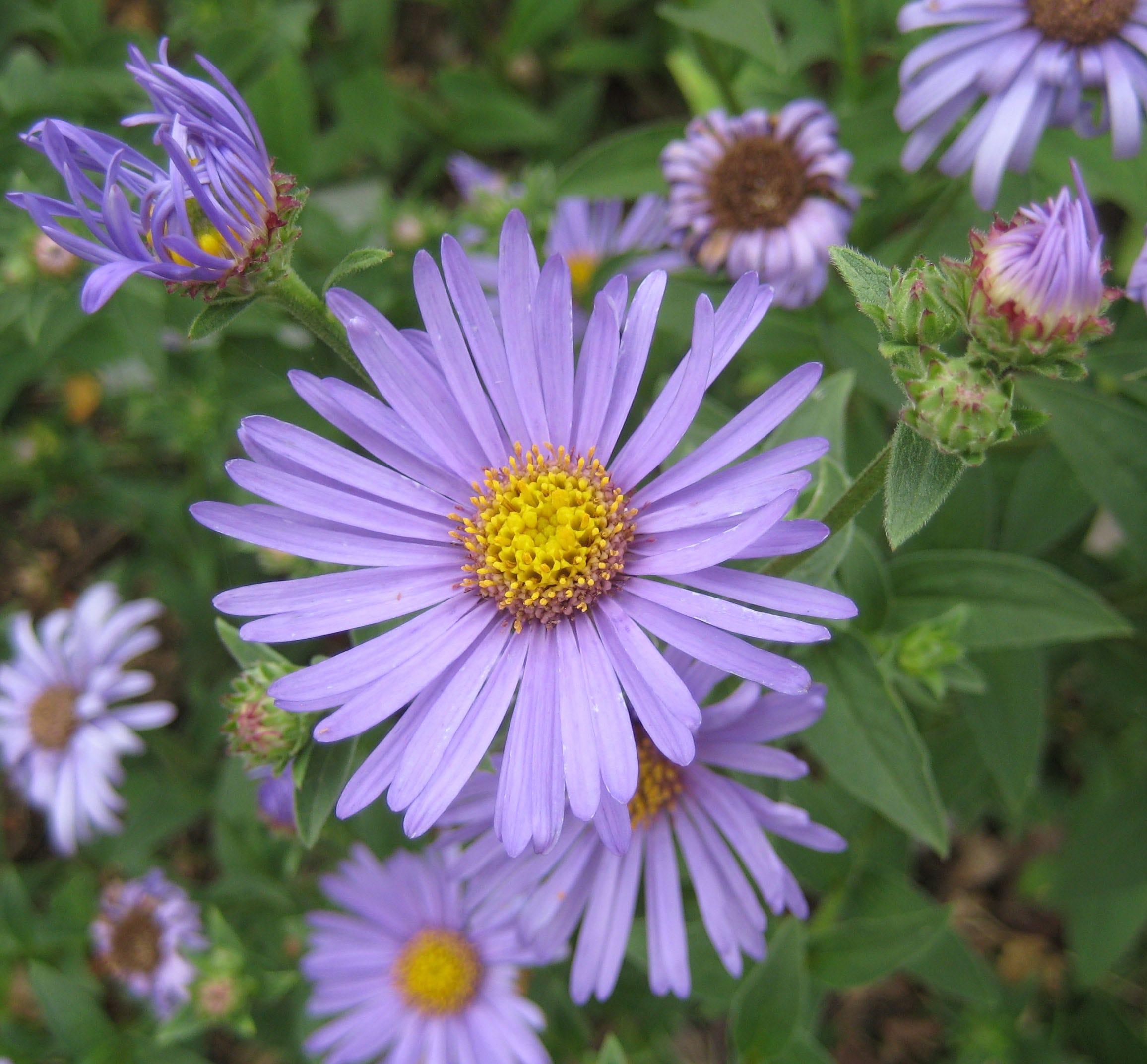
For autumn colour that will last until the frosts you really can’t beat a Michaelmas Daisy – and here’s an old rhyme to end with:
The Michaelmas Daisies, among dede [dead] weeds, / Bloom for St Michael’s valorous deeds. / And seems the last of flowers that stood, / Till the feast of St. Simon and St. Jude.
(The Feast of St. Simon and Jude is 28 October)
*The Chelsea Chop - to cut down all or some of the growth of some summer- and autumn-flowering perennials in late May – about the time of the Chelsea Flower Show – to limit the size of the plant and to promote longer flowering later in the season.
To finish with, here’s a
Just for fun Quiz
Do you know your butterflies? Which of the following are not butterflies?
1. Comma
2. Common blue
3. Field brown
4. Gatekeeper
5. Silver-washed fritillary
6. Painted lady
7. Red captain
8. Purple emperor
9. Speckled copse
10. White admiral
(Answers at the end of the post)
Picture credits:
Eranthis, Galanthus, Nectaroscordum, St. Michael, both Blackberry pictures - Pixaby
All other pictures my copyright.
‘Butterfly’ answers:
3 There is a Meadow brown, but not a Field brown
7 There is a Red admiral but not a Red captain
9 There is a Speckled wood but not a Speckled copse