

August

Welcome to my offering for August. You will notice that I have written ‘offering’, single. This is because I am reducing my articles to just once a month. As always, they are free to read.
I’m cutting down a little because other commitments are coming to the fore, including a number of wine tastings. As well as a garden author and writer, I am also a wine educator, having studied with the Wine and Spirit Education Trust (WSET). I enjoy both garden writing and leading wine tastings, so I have the best of both worlds. Cheers to that!
So without more ado, here is what’s coming up this month.
We have:
· my Pollinator Plant of the Month
· we’re taking a look at pairing vegetable dishes with wine – yes, I had to get wine in somewhere this month!
· a book that I’ve enjoyed
First, here’s my
Pollinator Plant of the Month
Calamintha is one of those plants that you rarely see at a garden centre1. This is a pity because in a study2 it was placed consistently in the top five plants that attract all kinds of pollinating insects, including bees and butterflies.
Look out too, for the aptly named mint moth which visits many plants in the Lamiaceae family, of which Calamintha is a member.
Its two-lipped flowers are very similar in appearance to those borne on other plants belonging to the Lamiaceae family, such as Lavandula, Nepeta and Salvia. They provide a profusion of nectar from high summer through to late autumn. Its leaves have a scent like that of a cross between oregano and mint.
Calamintha is a hardy deciduous perennial, so it will come back year on year. It will grow to about 60cm in height with a spread of 40cm. It’s a sun worshipper, so choose a spot with free-draining soil and it will be very happy.
There are a few to look out for. First is Calamintha nepeta ‘White Cloud’ (pictured) which has chalky-white flowers and the second is C. nepeta ‘Blue Cloud’ with – you’ve guessed it – pale blue-lilac flowers, as has C. nepeta ‘Marvelette Blue’ (pictured).
1 My local nursery, Holden Clough Nurseries (www.holdenclough.com) always has it in stock, though.
2 https://tinyurl.com/y6xyfxmn


Let’s look now at
Pairing Vegetable Dishes with Wine
I thought I would link two of my interests (gardening and wine) with a special look at pairing wines with vegetables – yes, vegetables! Why? I hear you ask. Well, there’s quite a lot of received wisdom and information out there about what wine to serve with fish, say, or chicken, but not that much about what goes well with veggies. And as many of my readers grow veggies, and no doubt enjoy a glass of wine now and again, I thought, why not give a few ideas about what to drink with your home-made tomato sauce that tops off the pasta, for example.
So let’s start with tomatoes and a tasty tomato salad. Raw tomatoes are apparently difficult to pair up with a wine, but there are a couple of that will happily match the acidity and straight-from-the-vine sweetness. First whites – how about a New Zealand Sauvignon Blanc with its grassy and herby notes, or perhaps an Italian Verdicchio to match the acidity. You could also try a dry rosé – perhaps one from Provence.
Cooked tomatoes, in a sauce say, can cope with reds. Choose an Italian red – Primitivo from way down south, say, or a Chianti. After all, Italy is home to just about all things tomato-y (think pasta sauce or pizza topping) so see what Italians drink and you can’t go far wrong. Instead of an Italian Primitivo, why not try an American red Zinfandel – it’s the same grape variety, just a different name.
What about green beans or mangetout? Fresh from the garden, and lightly cooked, or even raw, you need something equally fresh and zippy to go with them. How about a Portuguese Vinho Verde with just a hint of spritz? This would go well with a fresh pea and mint soup that’s been lightly chilled too.
Another veg that always seems to be a bit-player, supporting the main ingredients in a lot of dishes is the humble onion. Why not give it centre-stage in an onion tart? Alsace in France is renowned for its onion tart, and what better to drink with it than a Pinot Gris from the same region.
One of my all-time favourite summer herbs is basil and you really can’t beat home-made pesto simply folded into linguine or spaghetti. There’s more going on than just the herb, though, there’s pine nuts, pecorino cheese, and oil, so you need a wine that will balance the flavours without overpowering them. How about a Chenin Blanc or unoaked Chardonnay? Either would work well.
So there we have just a few examples of wine to pair with veggies. Don’t be constrained by what I – or many others – suggest you should drink with what, though. Ultimately, my advice is to drink what you like because we all have different preferences – the important thing is to enjoy both the food you eat and the wine you drink. Bon Appetit and Santé!


Book
As it’s a while since I recommended a book I thought this month I would look at something written by Edward Thomas. He’s usually thought of as a war poet: he died in 1917 during the Battle of Arras. But rather than dwell on the atrocities and horrifying nature of war he makes us aware of those things in a much more subtle manner. Take his poem Cherry Trees which I mentioned in one of my May articles:
The cherry trees bend over and are shedding / On the old road where all that passed are dead, / Their petals, strewing the grass as for a wedding / This early May morn when there is none to wed.
So many men, so many would-be husbands and fathers, lost.
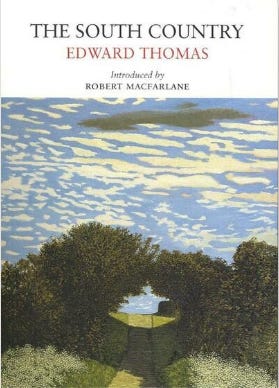
In addition to poetry, however, he wrote delicious prose. One such volume is entitled The South Country. One of the reasons I like it is because it includes musings and descriptions of the county where I was born: Sussex. Published in 1909, long before the horrors of the war, the book takes us on a journey along the byways of southern England.
In the chapter ‘Summer’ Thomas describes wayside flowers in an almost Impressionistic palette of colours:
‘there is blue of harebell and purple of rose-bay among the bracken and popping gorse, and heather and foxglove are purple above the sand, and the mint is hoary lilac, the meadow-sweet is foam, there is rose of willow-herb and yellow of flea-bane at the edge of the water, and purple of gentian and cistus yellow on the Downs, and infinite greens ….’
He is meticulously observant and attuned to the noises of the countryside. In the chapter ‘Going Westward’ he tells us that: ‘For a day white-throated convolvulus hides all the nettles of life. Of all the delicate passing things I have seen and heard – the slow, languid, gracious closing and unclosing of a pewit’s rounded wings as it chooses a clod to alight on; the sound of poplar leaves striving with the sound of rain in a windy summer shower; the glow of elms where an autumn rainbow sets a foot amongst them; […] – not one survives to compare with this gateway vision of a moment on a road I shall never travel again.
Some have criticised this book for being too disjointed without a unifying thread. But I disagree – true, it includes imaginary as well as real musings, but the unifying thread is Thomas himself. As Robert Macfarlane writes in the Introduction to the edition I am reading: ‘At its best, The South Country is a sustained prose-poem, strange and visionary in its disconnections, and brilliant in its noticings.’
To my mind, Edward Thomas, who died too young at the age of just 39, was a genius of both poetry and prose.
The South Country by Edward Thomas. This edition published in 2009 by Little Toller Books, Dorset. ISBN 978-0-9562545-1-1
Picture credits: Tomatoes, pasta, mange tout, onions, basil: Pixabay. All others my copyright.